“Pumpfoiling – flying over the water propelled only by the rider’s force”
What Is Pumpfoiling?
Pumpfoiling, also known as foil pumping, is a hydrofoil sport in which the rider generates forward motion and lift through a pumping movement rather than relying on wind, waves or a tow.
A hydrofoil mounted beneath the board lifts the rider above the water. By repeatedly shifting weight and moving the foil through the water, the rider can maintain speed and continue riding across flat water with no sail, wing or kite.
What Equipment Do You Need for Pumpfoiling?
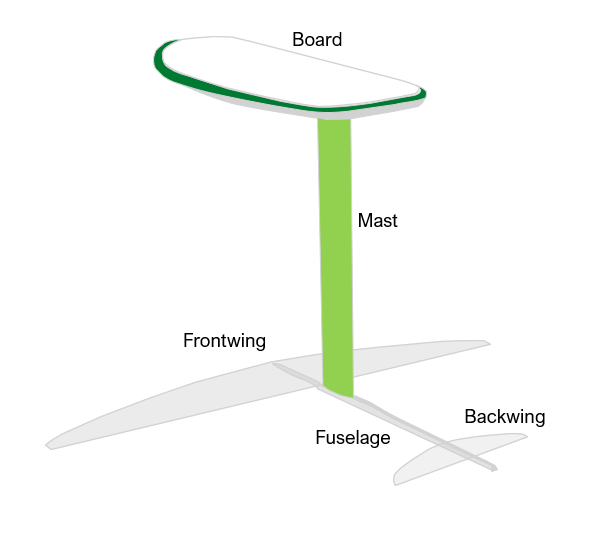
A pumpfoil setup consists of a foil board, mast, fuselage and hydrofoil. Unlike wingfoiling, windfoiling or kitefoiling, pumpfoiling does not require a sail, wing or kite to generate propulsion.
While pumpfoiling, the foil remains under water and generates the force to lift the rider with his board out of the water. The foil (hydrofoil) principle is the same as the wing of an airplane.
The board provides the platform from which the rider starts and controls the foil. Pumpfoil boards are typically designed to provide enough stability for takeoff while remaining efficient once the board is flying.
The hydrofoil sits beneath the board and generates lift as it moves through the water, allowing the board and rider to rise above the surface.
The mast connects the board to the underwater foil, while the fuselage connects the front and rear wings and helps control the foil's movement.
How Does Pumpfoiling Work?
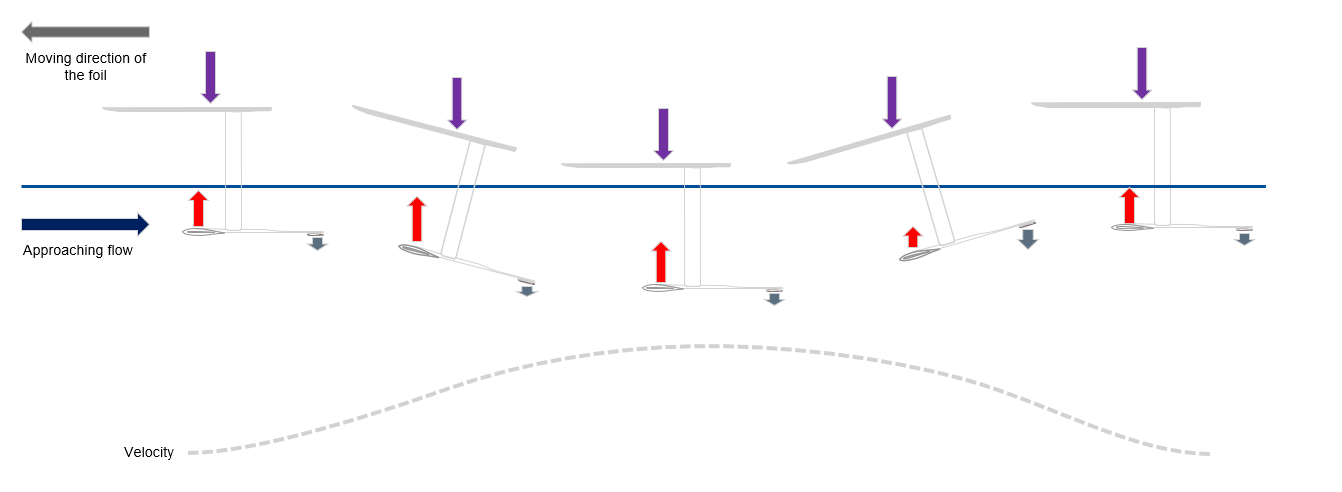
To generate the necessary lift, the foil must be agitated in a sinusoidal forward motion. The movement of the foil is shown schematically in the figure below.
In the figure, the foil moves from right to left. Due to the flow of the water around the foil, the front wing generates lift (red arrow) and the back wing generates downforce (grey arrow). The force induced by the pumpfoiler acts on the board connected to the foil (purple arrow).
At the beginning the pumpfoiler inclines the foil downwards in the direction of travel and thus accelerates the foil. Shortly before the board touches the surface of the water, the board is brought into an upward movement again by shifting the weight and giving an impulse with the back foot.
The speed gained by the “dive” leads to increased lift. The highest speed is reached when the foil reaches the lowest point in the movement sequence.